
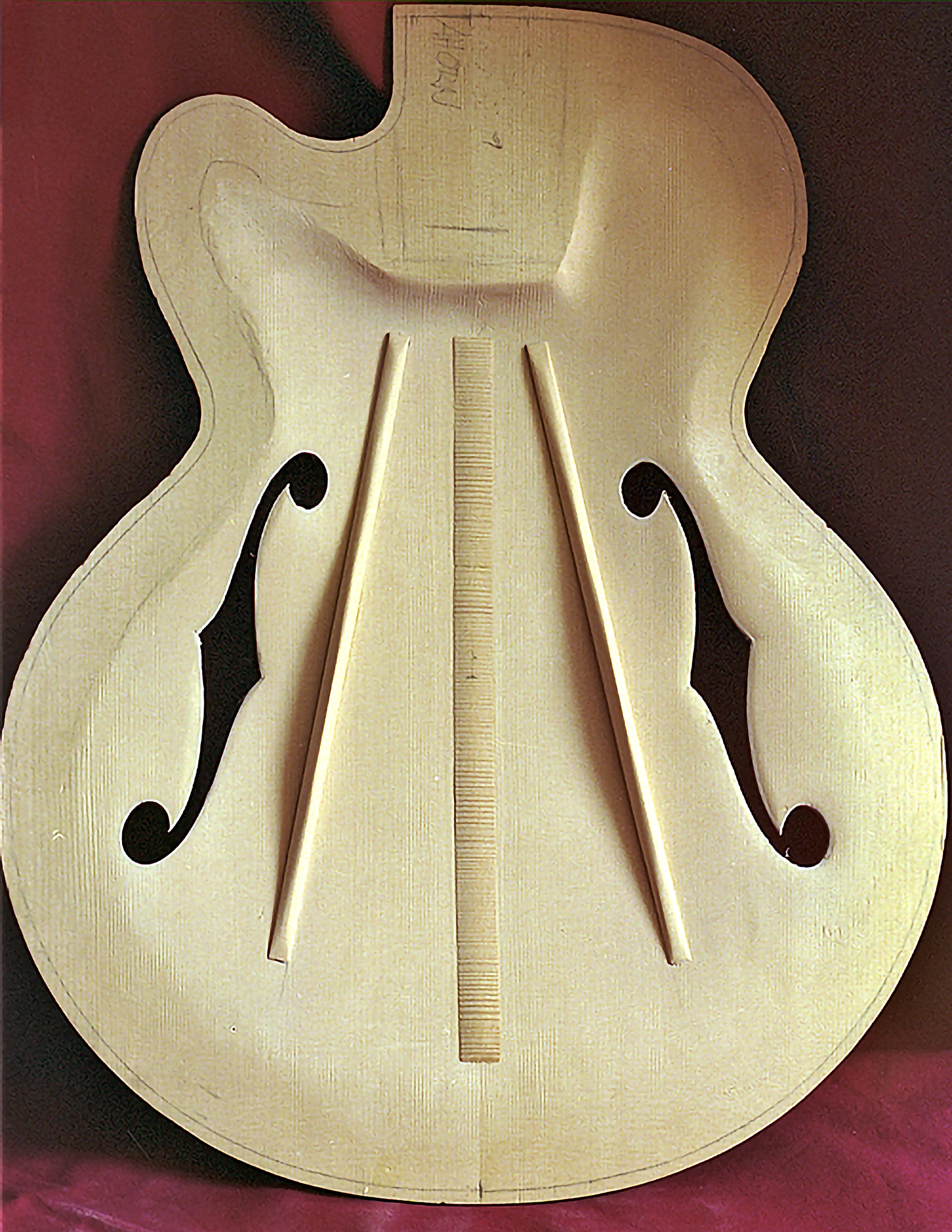
When purchasing an archtop jazz guitar, my customers often ask: “There are parallel and cross-braced guitar tops. What are they, and what are the differences?”
History
To explain this mystery, we must first take a look at the history of the jazz guitar: The archtop jazz guitar was invented and designed by Orville Gibson and his luthier, Lloyd A. Loar.
The first archtop guitars were Gibson models in the L-1 through L-4 series, built between the turn of the century and around 1930, featuring a round or oval soundhole and a carved, arched top. The top had to be reinforced against the tension of the strings, and to achieve this, Orville Gibson chose a system consisting of two braces. These had to be arranged parallel to the string tension in order to absorb it. But since the soundhole was cut into the top at the end of the fretboard, just in front of the bridge, the most practical arrangement for the beams was a cross, to support the top up to the point where the arch transitions to a flat surface.
When Lloyd Loar introduced the new L5 archtop model to the market in 1924, the rearrangement of the soundholes—which were now positioned on either side of the bridge in the shape of violin F-holes—opened up a new possibility for the bracing configuration. Since there was no longer a soundhole at the end of the fingerboard, the braces could now be run parallel almost all the way to the neck block.
Initially, Gibson used both bracing systems. But starting around 1940, the company began to favor parallel bracing, and shortly after the end of the war, it built only tops with parallel bracing.
Finally, there was one other company that used a third system: Stromberg. This manufacturer built guitars that had only one brace on the inside of the top. This brace was positioned at an angle.
Throughout the history of guitar making, however, the parallel and cross-bracing systems have been preferred. Other manufacturers, such as John D’Angelico and Epiphone, have always used both systems. D’Angelico, for example, built guitars to order and according to the customer’s desired sound.
Differences in Sound
Basically, it’s easy to explain: In my experience, parallel bracing produces a brighter, more delicate sound, while cross bracing tends to sound drier—and perhaps a bit darker as well.
These differences arise because the parallel braces stiffen the top more in the direction of the strings’ tension. With cross-bracing, on the other hand—and the wider the angle of the cross, the more so—the top becomes progressively softer.
So we have the rule of thumb: The stiffer the top, the brighter the sound. But keep in mind, this is just a rule of thumb. There are many other factors involved in the building process that influence the sound and that the luthier must take into account.